
Biceps and Triceps Workout: 8 Best Exercises for Stronger, Toned Arms
Strong arms aren’t just about how they look in a T-shirt. Your biceps and triceps play an important role in everyday movements, from carrying groceries and lifting objects to pushing, pulling, and performing other upper-body exercises.
But here’s the thing: you don’t need an endless arm workout to make your training more effective.
A well-structured biceps and triceps workout with the right exercises, controlled form, and consistent training can help you build stronger, more capable arms.
Whether you’re a beginner stepping into the gym for the first time or someone looking to add more variety to their routine, these 8 biceps and triceps exercises can give your arm day a clear direction.

Why Train Your Biceps and Triceps Together?
Your biceps sit at the front of your upper arm and are heavily involved in elbow flexion and pulling movements. Your triceps are located at the back of the upper arm and contribute to elbow extension and pushing movements.
Training both muscle groups gives your workout a balanced approach to arm strength.
More importantly, strong arms can support other upper-body movements. Exercises such as rows, presses, pulls, and carries all rely on the muscles around your arms working effectively.
And if your goal includes more visible muscle definition, remember that consistent resistance training matters far more than trying to destroy your arms in a single workout. The American College of Sports Medicine’s 2026 resistance-training guidance emphasizes consistency and matching training variables to your specific goal.
So, let’s get into the exercises.
8 Best Biceps and Triceps Exercises for Your Arm Workout
1. Hammer Curls
Primary target: Biceps
Equipment: Dumbbells
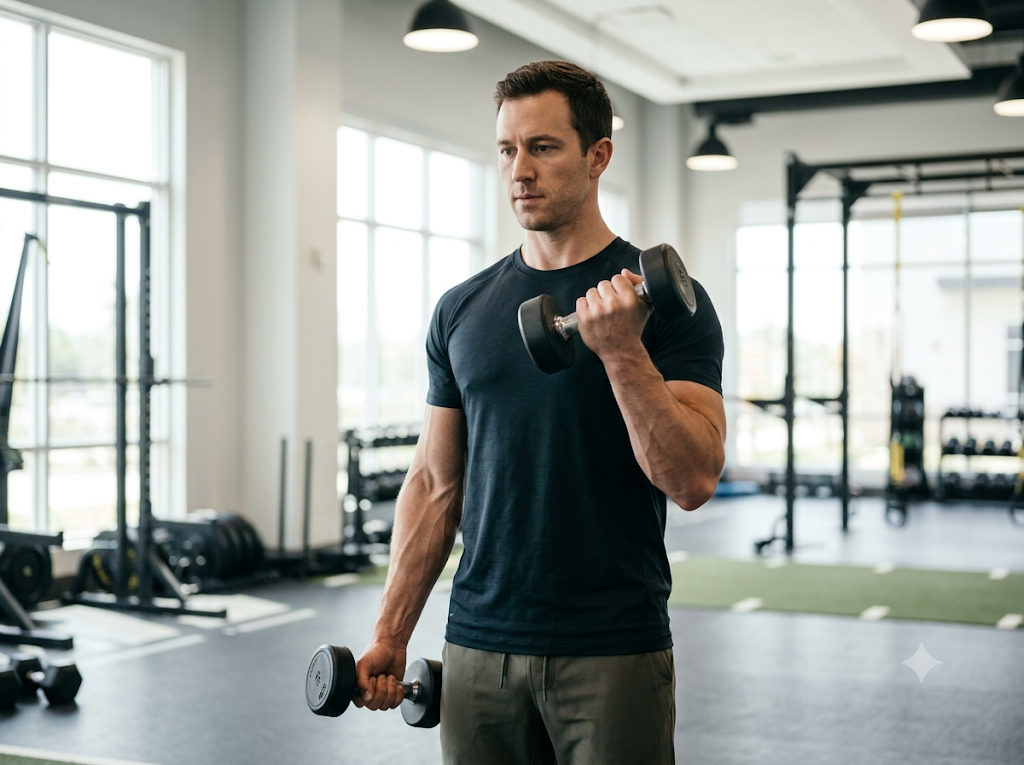
Hammer curls are a simple place to start your biceps workout.
Stand tall with a dumbbell in each hand and keep your palms facing inward. Curl the weights toward your shoulders while keeping your elbows close to your body. Lower the dumbbells slowly instead of allowing them to drop.
Form tip: Keep your elbows relatively still and avoid swinging your body to move the weight.
Why include it? Hammer curls are an accessible variation that can train the elbow flexors while also involving the forearm muscles.
2. Concentration Curls
Primary target: Biceps
Equipment: Dumbbell and bench
Sit on a bench with your legs positioned comfortably apart. Hold a dumbbell in one hand and place the back of your upper arm against your inner thigh.
Now curl the dumbbell toward your shoulder while keeping the upper arm stable. Pause briefly at the top before lowering the weight with control.
This exercise encourages you to focus on the working arm rather than relying on momentum.
Pro tip: A lighter weight with controlled movement can be more useful than a heavier weight that causes your form to break down.
3. Cable Curls
Primary target: Biceps
Equipment: Cable machine
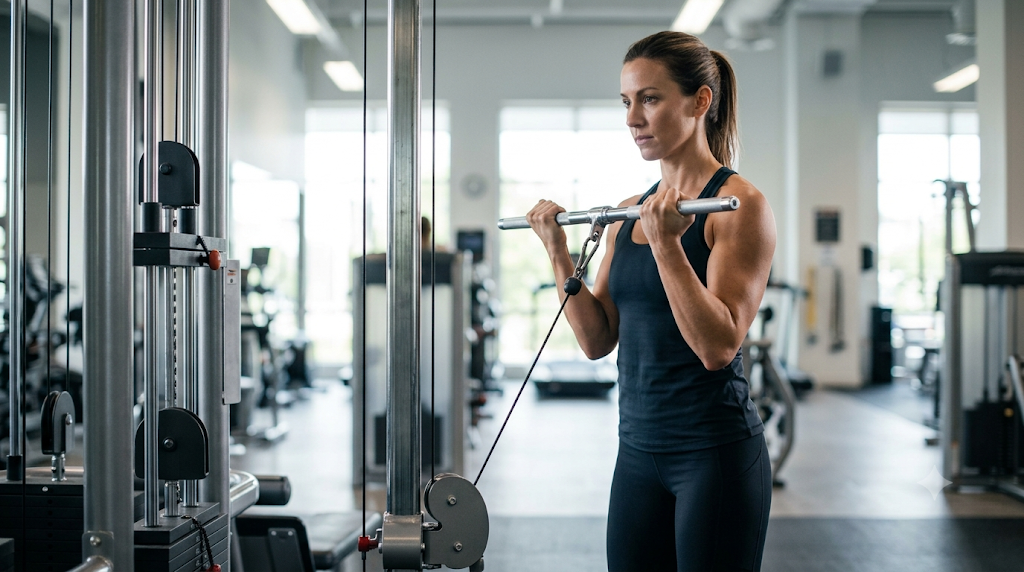
Cable curls are a great option when you want to add variety to your arm workout.
Set the cable at a low position and stand facing the machine. Keep your elbows close to your torso as you curl the handle upward toward your shoulders.
Pause briefly at the top, then lower the weight under control.
The goal isn’t simply to move the cable stack. Focus on making your biceps do the work.
4. Barbell Curls
Primary target: Biceps
Equipment: Barbell
The barbell curl is a classic biceps exercise for a reason.
Stand with your feet about shoulder-width apart and hold the barbell with an underhand grip. Keep your elbows close to your sides and curl the bar toward your shoulders.
Then lower it slowly.
The biggest mistake? Turning the exercise into a full-body swing.
Keep your torso stable and use controlled movement rather than momentum.
5. Cable Triceps Pushdowns
Primary target: Triceps
Equipment: Cable machine
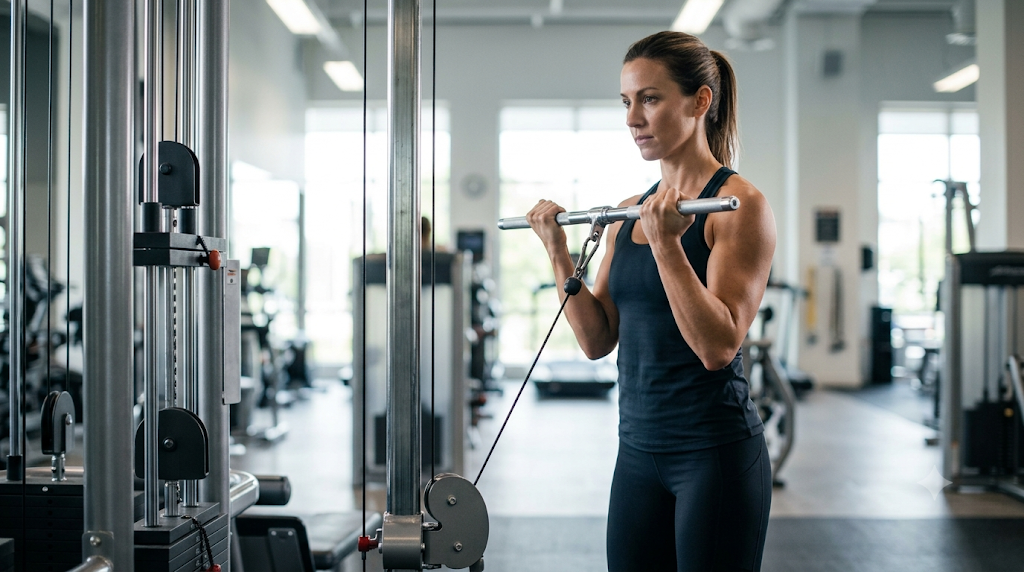
Now it’s time to shift your attention to the back of the arm.
Stand facing the cable machine and grip the bar or attachment. Keep your elbows close to your sides and push the handle downward until your arms are extended.
Slowly return to the starting position.
Form tip: Don’t automatically reach for the heaviest weight available. Excessive load can make it harder to maintain proper technique and may encourage your shoulders or torso to compensate.
6. Resistance Band Triceps Pushdowns
Primary target: Triceps
Equipment: Resistance band
No cable machine? No problem.
A resistance band can provide a convenient alternative for triceps training when you have an appropriate and secure anchor point.
Attach the band securely above you, check the setup, and stand with your feet about hip-width apart. Keep your elbows close to your body and press the band downward.
Return slowly to the starting position.
Safety first: Always check that the anchor point and band are secure before beginning.
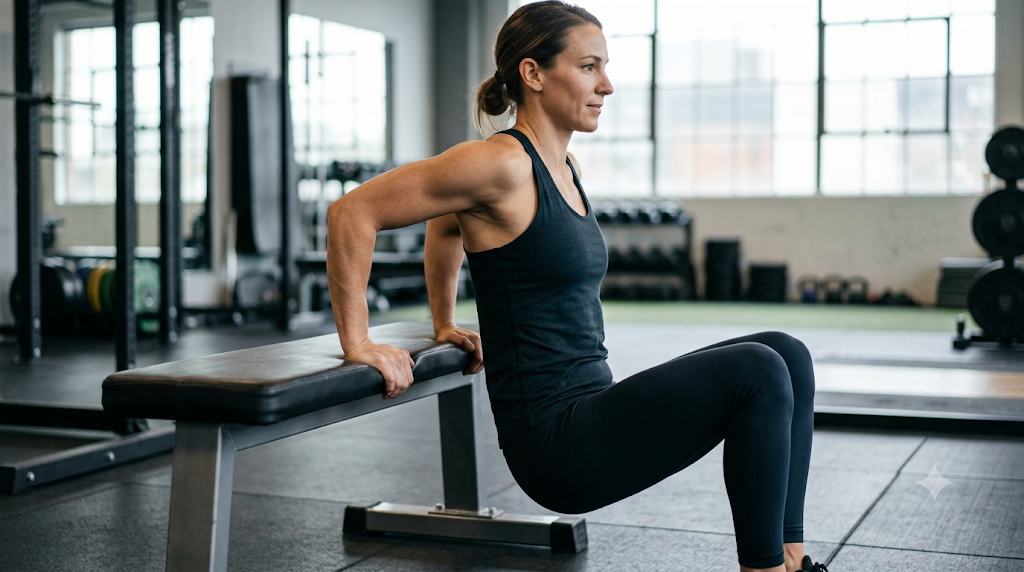
7. Bench Dips
Primary target: Triceps
Equipment: Sturdy bench or elevated surface
Bench dips use your body weight to challenge your triceps.
Place your hands on the edge of a stable bench, with your fingers facing forward. Move your body slightly away from the bench and lower yourself by bending your elbows.
Then press through your hands to return to the starting position.
If standard bench dips feel too demanding, a bent-knee variation can provide additional assistance.
Important: Use a stable surface and stop if you experience pain, particularly around the shoulders.
8. Overhead Triceps Extensions
Primary target: Triceps
Equipment: Dumbbell
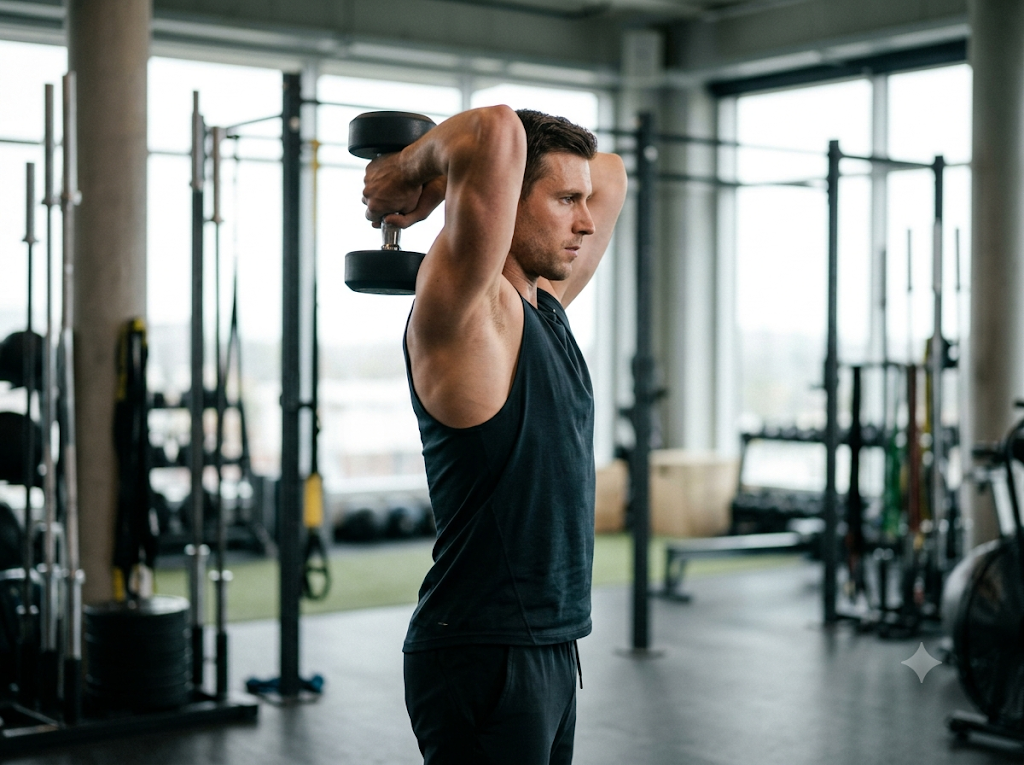
Hold one dumbbell with both hands or use a weight in each hand. Raise the weight overhead while keeping your core engaged.
Bend your elbows and slowly lower the weight behind your head. Then extend your elbows to bring the weight back overhead.
Try to keep your chest stacked over your hips rather than arching your lower back.
This movement gives you another way to train the triceps while adding variety to your upper-body workout.
How to Structure Your Biceps and Triceps Workout
You don’t necessarily need to perform every arm exercise separately with long rest periods.
One approach used in the source workout is to organize exercises into biceps and triceps supersets, completing multiple rounds with rest between supersets.
For example:
| Block | Exercise | Muscle |
|---|---|---|
| A | Hammer Curl | Biceps |
| A | Concentration Curl | Biceps |
| B | Cable Triceps Pushdown | Triceps |
| B | Overhead Triceps Extension | Triceps |
You can then rotate through the blocks according to your training level and goals.
If you’re new to resistance training, start conservatively and prioritize technique. As you become more comfortable, training variables such as load, volume, and exercise selection can be adjusted to match your goal. ACSM’s current guidance emphasizes consistency and individualized training rather than searching for one universally perfect routine.
Don’t Skip Your Warm-Up
Before jumping into curls and extensions, spend a few minutes preparing your upper body.
Try:
- Arm circles
- Light band pull-aparts
- Gentle dynamic shoulder movements
The original Snap Fitness routine includes arm circles and band pull-aparts as part of its warm-up.
[Image Required: Person performing resistance-band warm-up before arm workout]
A short warm-up can help you transition into your workout rather than going from zero movement straight into loaded exercises.
How Often Should You Train Your Arms?
The right frequency depends on your overall training program, experience, recovery, and goals.
Instead of thinking, “How many arm workouts can I squeeze into one week?”, think about how your arm training fits into your entire resistance-training schedule.
Remember that your biceps and triceps are also involved in many compound upper-body exercises. Your total weekly training load therefore matters—not just the number of curls and extensions you perform.
Consistency is the bigger picture.
A workout you can perform consistently with good technique is generally more useful than an extreme routine you can’t maintain.
Can You Get Toned Arms From These Exercises?
Here’s where expectations matter.
Exercises can help you build and strengthen the muscles in your arms, but the appearance of your arms is influenced by more than resistance training alone.
If your goal is greater muscle definition, consider your overall training, nutrition, activity level, recovery, and individual body composition.
So don’t chase a magical “toning” exercise.
Instead, focus on building stronger muscles and following a sustainable fitness routine.
Make Your Arm Workouts Count
You don’t need dozens of exercises to make your next biceps and triceps workout worthwhile.
Start with a manageable selection. Learn the movement. Control the weight. Keep your technique consistent. Then gradually adjust your training as your experience develops.
And don’t forget the basics: adequate recovery and consistency are part of the process too.

Ready to Build Stronger Arms?
Your next arm workout doesn’t have to be complicated.
From hammer curls and barbell curls to triceps pushdowns and overhead extensions, these eight movements give you several ways to train the front and back of your upper arms.
The key is not simply doing more.
It’s training with purpose.
Start with movements you can perform safely and confidently, focus on controlled technique, and build your routine over time.
If you’re unsure how to structure your workout or which exercises are appropriate for your experience level, consider working with a qualified fitness professional who can help you adapt your training to your individual needs.
Strong arms start with a consistent routine. Make your next workout count.